
Overview
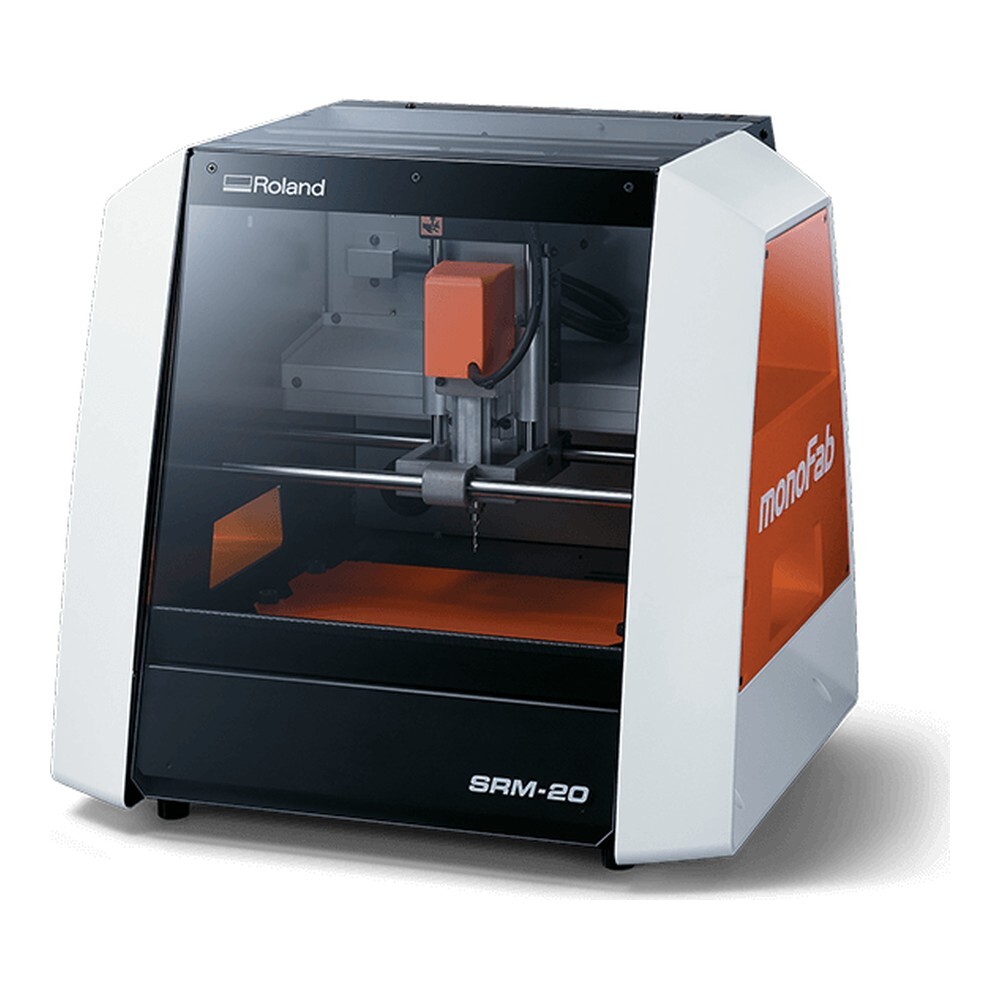
The Roland SRM-20 is a compact desktop CNC milling machine for producing realistic parts and prototypes from a desk, bench or classroom. It mills modelling wax, chemical wood, foam, acrylic, poly acetate, ABS and PC board within a 203.2 × 152.4 × 60.5 mm operating range, and is designed so that users without expert machining skills can achieve precise results.
For product designers, engineering workshops, schools, universities and makerspaces, the SRM-20 is a practical way to turn CAD data into physical test pieces, check fit and function, and refine a design before committing to final manufacture.
Realistic Prototypes in Production-Like Materials
Because the SRM-20 cuts engineering plastics such as ABS, acrylic, PC board and poly acetate, prototypes can look and behave much like the finished part, including complex snap fits. Modelling wax and foam suit quick form studies and wax moulds for casting.
Precise Contours With a Micro-Step Drive
A micro-step motor drive system produces clean, precise contours, with a mechanical resolution of 0.000998594 mm/step. Roland quotes a feed rate twice as fast as previous generations, with an operating speed of 6–1,800 mm/min and spindle speed adjustable from 3,000 to 7,000 rpm.
Simple Control With VPanel
The on-screen VPanel controller sets the tool position and milling origin, adjusts feed rate and spindle speed, and pauses or resumes jobs. A numeric readout tracks the X, Y and Z axes in millimetres or inches.
Independent Collet System
There is no need to change the spindle for each end mill shank diameter: simply fit the matching collet chuck. This speeds up setting the Z-axis base point and makes tool changes quick.
Enclosed, Clean and Durable
A fully enclosed cabinet reduces dust and noise, and a side window lets you watch progress. A safety interlock pauses milling when the cover is opened and resumes once it is closed and “continue” is selected. Airtight sealing keeps milling debris out of the spindle and Y-axis for long-term reliability.
Bundled Software and G-Code Support
A software suite is available from Roland OnSupport, led by SRP Player CAM, which reads STL, DXF, Rhino 3D Model and IGES files. MODELA Player 4, iModela Creator, Virtual MODELA, ClickMill and SFEdit2 cover simple STL milling, sketch-to-mill design, simulation, direct surfacing and drilling, and single-line engraving fonts. The machine accepts RML-1 and NC code, so G-code from other CAM software can be used.
Applications
- Product prototypes realistic test parts for new inventions, including complex snap fits
- Wax moulds for casting precise patterns milled in modelling wax
- Tools and machinery parts small components to test before final manufacture
- Relief plaques and graphics textured and relief work in wax, wood or plastics
- Vehicle prototypes scale models and parts for design and engineering projects
- Game and model parts miniature components and figures
- Art and design concepts physical studies of creative ideas
- STEM and STEAM education hands-on prototyping for schools, universities and makerspaces
Specifications
| Model | SRM-20 | |
| Cuttable material | Modeling Wax, Chemical Wood, Foam, Acrylic, Poly acetate, ABS, PC board | |
| X, Y and Z operation strokes | 203.2 (X) × 152.4 (Y) × 60.5 (Z) mm, 8 (X) × 6 (Y) × 2.38 (Z) inches | |
| Workpiece table size | 232.2 (X) × 156.6 (Y) mm, 9.14 (X) × 6.17 (Y) inches | |
| Distance from collet tip to table | Maximum 130.75 mm (5.15 in) | |
| Loadable workpiece weight | 2 kg (4.4 lbs) | |
| X-, Y- and Z-axis drive system | Stepping motor | |
| Operating speed | 6–1800 mm/min, 0.24–70.87 inch/min | |
| Software resolution | RML-1 | 0.01 mm/step (0.000039 inches/step) |
| NC code | 0.001 mm/step (0.000039 inches/step) | |
| Mechanical resolution | 0.000998594 mm/step, 0.0000393 inches/step | |
| Spindle motor | DC motor Type 380 | |
| Spindle rotation speed | Adjustable 3,000–7,000 rpm | |
| Cutting tool chuck | Collet method | |
| Interface | USB | |
| Control command sets | RML-1, NC code | |
| Power requirements | Machine | DC 24 V, 2.5 A |
| Dedicated AC adapter | AC 100–240 V ±10 %, 50/60 Hz | |
| Power consumption | Approx. 50 W | |
| Operating noise | During operation | 65 dB (A) or less (when not cutting) |
| During standby | 45 dB (A) or less | |
| External dimensions | 451.0 (W) × 426.6 (D) × 426.2 (H) mm, 17.76 (W) × 16.80 (D) × 16.78 (H) inches | |
| Weight | 19.6 kg, 43.2 lbs | |
| Installation environment | Temperature of 5 to 40 °C (41 to 104 °F), 35 to 80 % relative humidity (no condensation) | |
| Included items | USB cable, AC adapter, Power cord, Cutting tool, Collet, Set screw, Spanners (7, 10 mm / 0.28, 0.39 inches), Hexagonal wrench (size 2, 3 mm / 0.059, 0.12 inches), Positioning pins, Double-sided tape, Start-up page guidance card | |
| Software | Available from Roland OnSupport | SRP Player, MODELA Player 4, iModela Creator, Virtual MODELA, ClickMill, SFEdit2 |
| System requirements | Operating system | Windows 7/8/8.1 (32-bit/64-bit edition) |
| CPU | Intel® Core 2 Duo or more (Core i5 or more recommended) | |
| Memory (RAM) | 1 GB (2 GB or more recommended) | |
| Video card and monitor | A resolution of 1,280 × 1,024 or more recommended | |
| Free hard-disk space | 100 megabytes or more recommended as a working space | |
| Other | Internet connection and web browser, Internet Explorer version 10 or more recommended |
FAQ
What materials can the SRM-20 mill?
Roland lists modelling wax, chemical wood, foam, acrylic, poly acetate, ABS and PC board. These cover everything from soft wax and foam for quick form studies to engineering plastics for realistic, functional prototypes. Metals are not on Roland's list for the SRM-20, so talk to DPI Technology before planning work in any other material.
How big a part can I make on the SRM-20?
The maximum operating range is 203.2 (X) × 152.4 (Y) × 60.5 (Z) mm on a 232.2 × 156.6 mm table. The maximum distance from the collet tip to the table is 130.75 mm, and workpieces can weigh up to 2 kg.
Which software comes with the SRM-20, and does it accept G-code?
A bundled software suite is available for download from Roland OnSupport: SRP Player CAM (which reads STL, DXF, Rhino 3D Model and IGES files), MODELA Player 4, iModela Creator, Virtual MODELA, ClickMill and SFEdit2. The machine accepts both RML-1 and NC code, so G-code programs from other CAM packages can also be used.
What computer and power supply does the SRM-20 need?
It connects to a Windows PC by USB. Roland's published requirements are Windows 7/8/8.1 (32- or 64-bit), an Intel Core 2 Duo or better (Core i5 or better recommended), 1 GB RAM (2 GB or more recommended) and a 1,280 × 1,024 display or higher. Power comes from the supplied AC adapter (AC 100–240 V ±10 %, 50/60 Hz) and consumption is approx. 50 W. DPI Technology can confirm compatibility with your current Windows version before installation.
Is the SRM-20 suitable for classrooms and makerspaces?
Yes. Roland designed it for office, home and classroom use. The fully enclosed cabinet reduces dust and noise, a safety interlock pauses milling when the cover is opened, and operating noise is 65 dB (A) or less when not cutting. At 451 × 426.6 × 426.2 mm and 19.6 kg it fits on a desk or bench.
Manufacturer information: Roland SRM-20 Compact Milling Machine (Roland DG)